A fasting blood sugar test shows your glucose level at one moment. The HbA1c test gives a longer view: it tells you and your doctor how your blood sugar has behaved over the past weeks and months.
Key points
- HbA1c reflects your average blood sugar over roughly the last two to three months.
- You do not need to fast for this test on its own.
- Doctors use it to look for prediabetes and type 2 diabetes, and to follow people who already have diabetes.
- Some conditions, such as anaemia, thalassaemia, kidney disease and pregnancy, can make the result less reliable.
- A single result is not a diagnosis. Your doctor interprets it together with your health history and other tests.
What HbA1c measures
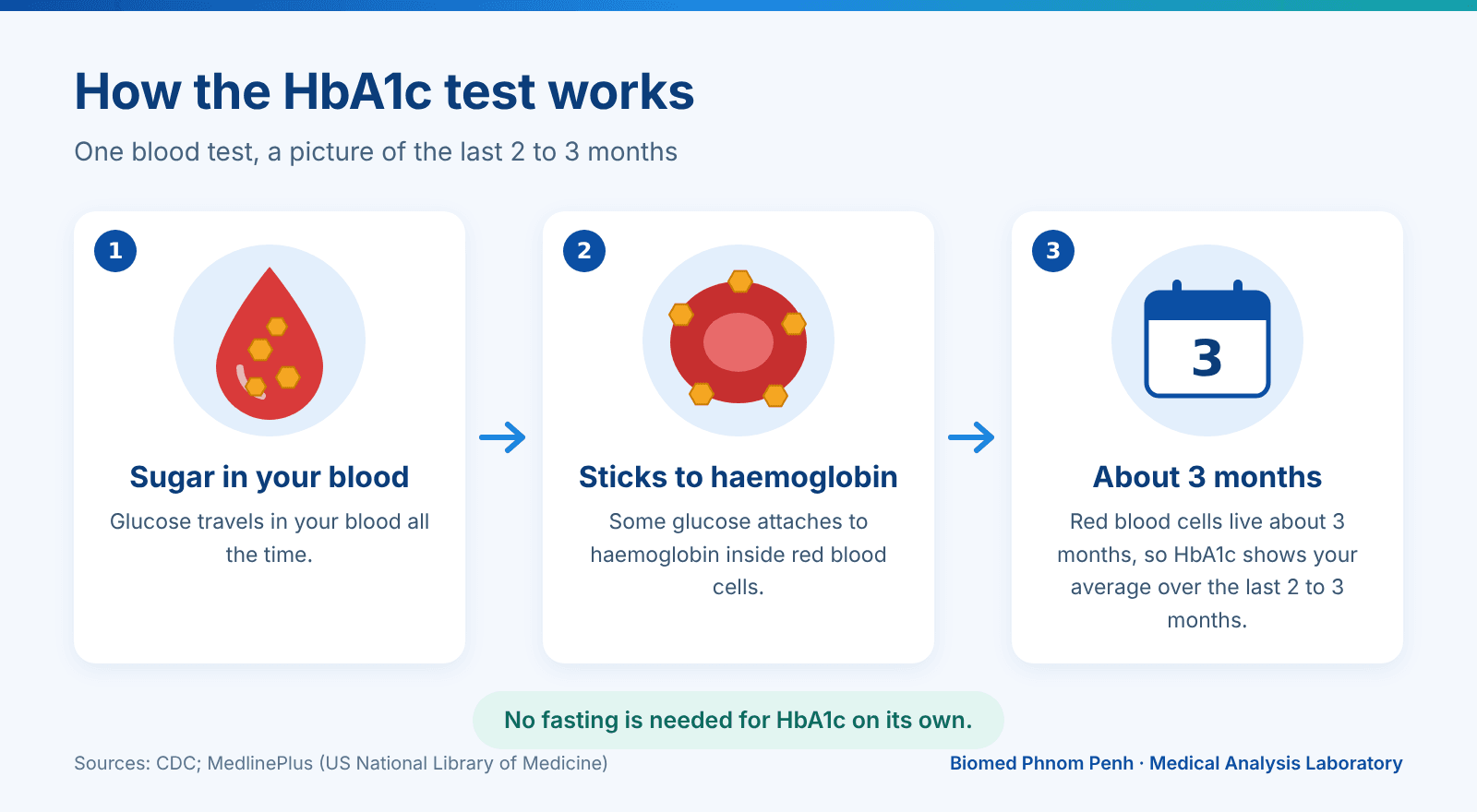
Haemoglobin is a protein inside your red blood cells. Glucose in the blood attaches to it and stays attached for as long as the red blood cell lives, which is about three months. The HbA1c test measures how much of your haemoglobin has glucose attached and reports it as a percentage. The higher your blood sugar has been on average, the higher the percentage.
The test is also called A1C or glycated haemoglobin.
When doctors request it
Doctors request HbA1c for two main reasons: to check whether a person may have prediabetes or type 2 diabetes, and to see how well blood sugar has been controlled in someone who already has diabetes. The US Centers for Disease Control and Prevention (CDC) says that most people with diabetes have the test at least twice a year. It also advises testing for adults over 45 and for younger adults who are overweight or have other risk factors.
HbA1c is not the test used to find diabetes that appears during pregnancy, and it is not used to diagnose type 1 diabetes.
This matters in Cambodia. The national STEPS survey of 2023, led by the Ministry of Health with support from the World Health Organization (WHO), found that 6.3% of adults aged 18 to 69 had raised fasting blood sugar or were taking medicine for it. The figure was about 13% in people aged 45 to 59 and 20% in people aged 60 to 69. WHO notes that the symptoms of type 2 diabetes can be mild and may go unnoticed for years, so the disease is often found late. Regular check-ups and blood tests are the best way to find it early.
How to prepare
HbA1c needs no fasting and the blood can be taken at any time of day. A small sample is drawn from a vein in your arm.
Doctors often request other tests at the same visit. Fasting blood sugar and lipid tests do require fasting, so if your request form includes them, come fasting. If you are not sure, ask your doctor or call our hotline on 078 609 609.
Tell your doctor about all the medicines you take and whether you are pregnant, because both can influence the result. Do not stop any medicine unless your doctor tells you to.
Biomed is open every day from 6:30 AM to 4:00 PM and you do not need an appointment. Routine results are ready the same day at 3:00 PM. You can read your result online by scanning the QR code on your receipt, or through the BIOMED LAB BOT on Telegram.
How results are reported
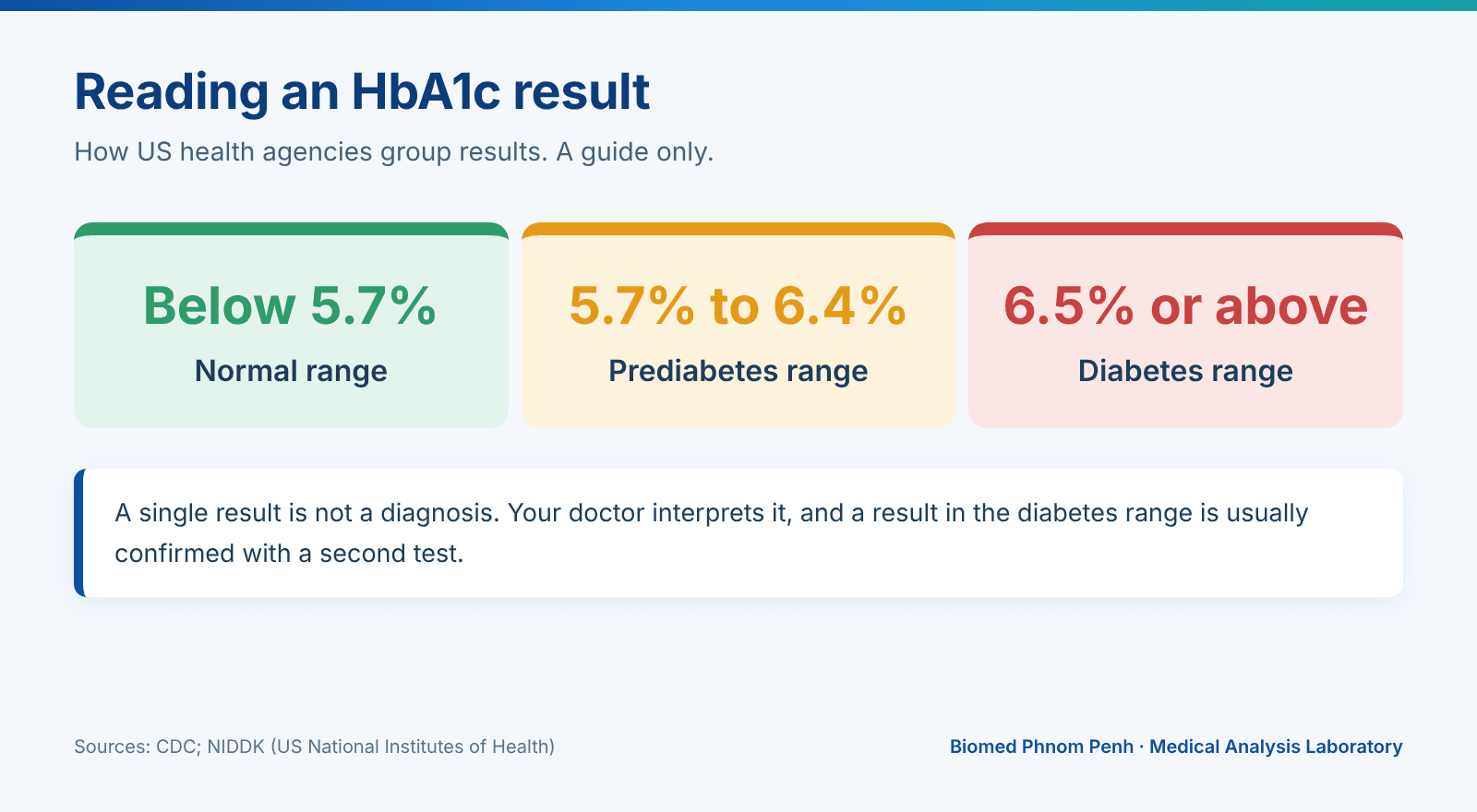
The result is given as a percentage. US health agencies describe a result below 5.7% as normal, 5.7% to 6.4% as the prediabetes range, and 6.5% or above as the diabetes range. These figures are a guide only. What is right for one person depends on age, general health and other factors.
When a person has no symptoms, a result in the diabetes range is normally confirmed with a second test on another day before a diagnosis is made. For people who already have diabetes, the target HbA1c is personal and is agreed with the doctor.
When the result can be misleading
Because the test depends on red blood cells, anything that changes them can push the result up or down without any real change in blood sugar. Examples include severe anaemia, iron deficiency, recent blood loss or a blood transfusion, kidney failure, liver disease, pregnancy and some medicines.
Inherited haemoglobin variants, including thalassaemia, can also interfere with some HbA1c test methods. The US National Institute of Diabetes and Digestive and Kidney Diseases (NIDDK) notes that these variants are more common in people of Southeast Asian descent, among others. If you or a family member has thalassaemia or another blood disorder, tell your doctor. Your doctor may choose a different test to check your blood sugar.
This article is general information, not medical advice. Please discuss your results and any health concerns with your doctor.
References
- A1C Test for Diabetes and Prediabetes. US Centers for Disease Control and Prevention (CDC). https://www.cdc.gov/diabetes/diabetes-testing/prediabetes-a1c-test.html
- The A1C Test & Diabetes. National Institute of Diabetes and Digestive and Kidney Diseases (NIDDK), US National Institutes of Health. https://www.niddk.nih.gov/health-information/diagnostic-tests/a1c-test
- Hemoglobin A1C (HbA1c) Test. MedlinePlus, US National Library of Medicine. https://medlineplus.gov/lab-tests/hemoglobin-a1c-hba1c-test/
- Diabetes (fact sheet). World Health Organization. https://www.who.int/news-room/fact-sheets/detail/diabetes
- Prevalence of non-communicable disease risk factors and conditions in Cambodia: STEPS survey Country Report, 2023. Ministry of Health, Kingdom of Cambodia, with support from WHO. https://cdn.who.int/media/docs/default-source/ncds/ncd-surveillance/data-reporting/cambodia/cambodia-2023-steps-report-english-final.pdf